Stop reading API responses like walls of text.
The visual workspace for API responses.
JSONFiddle turns raw REST responses, webhook payloads, logs, and large JSON files into graphs, grids, queries, exports, schemas, and shareable debugging context.
No setup for the free tools. Your data stays in the browser for local workflows.
{
  "order": {
    "id": "ORD-0427",
    "customer": {
      "tier": "enterprise",
      "region": "us-east"
    },
    "items": [
      { "sku": "API-PRO", "qty": 12 }
    ]
  }
}"ORD-0427"API-PRO12Paste or fetch
Drop in a REST response, webhook payload, log line, config, or file export.
See the shape
Switch between graph, explorer, grid, and query views without reformatting.
Extract and prove
Filter nested arrays, flatten columns, validate schemas, generate types, and export CSV.
One payload. Four ways to understand it.
Developers can inspect structure, support teams can read meaning, and non-technical users can export the slice they need without writing scripts.
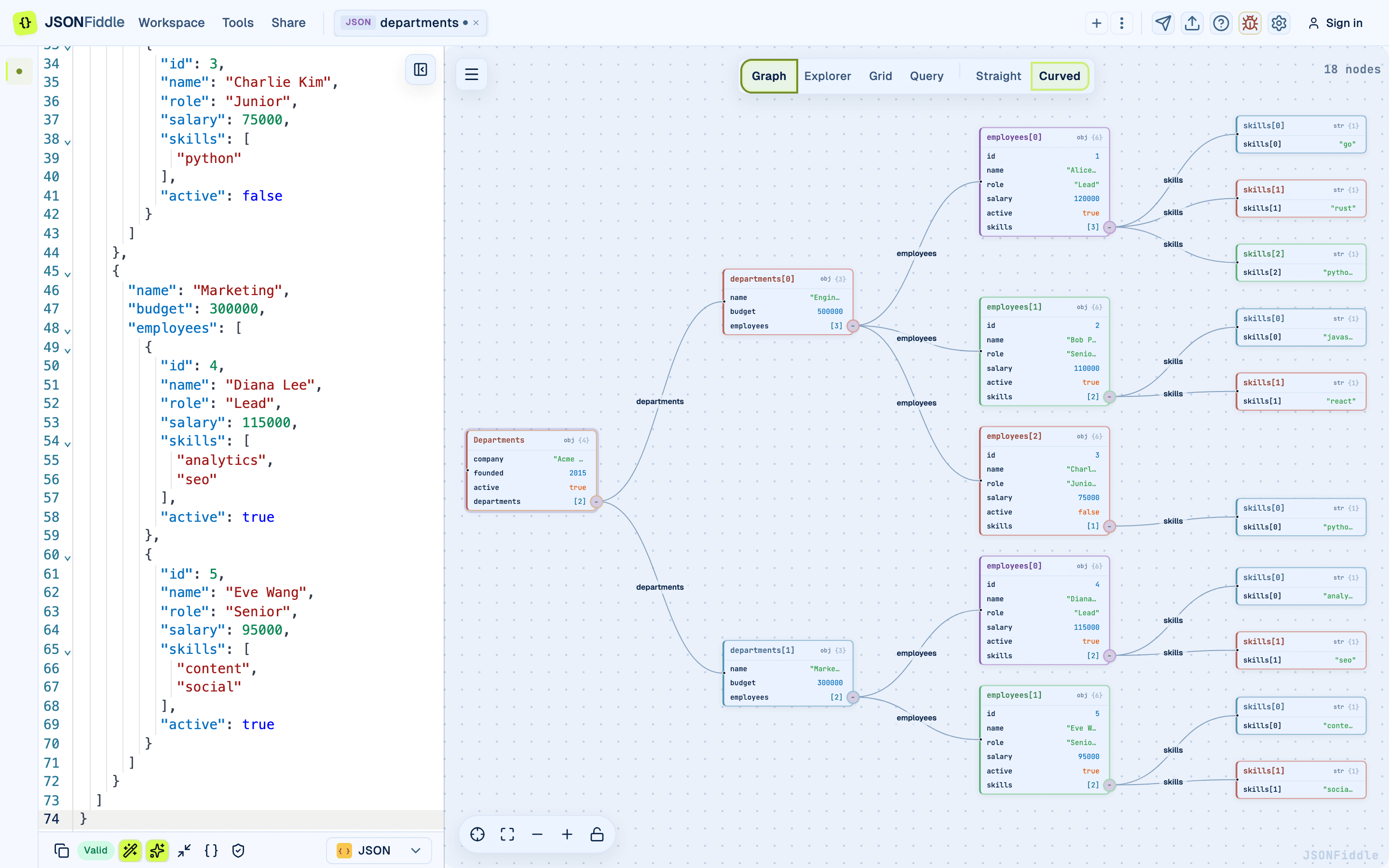
Graph
Trace relationships and nested fields visually, with animated edges and searchable nodes.
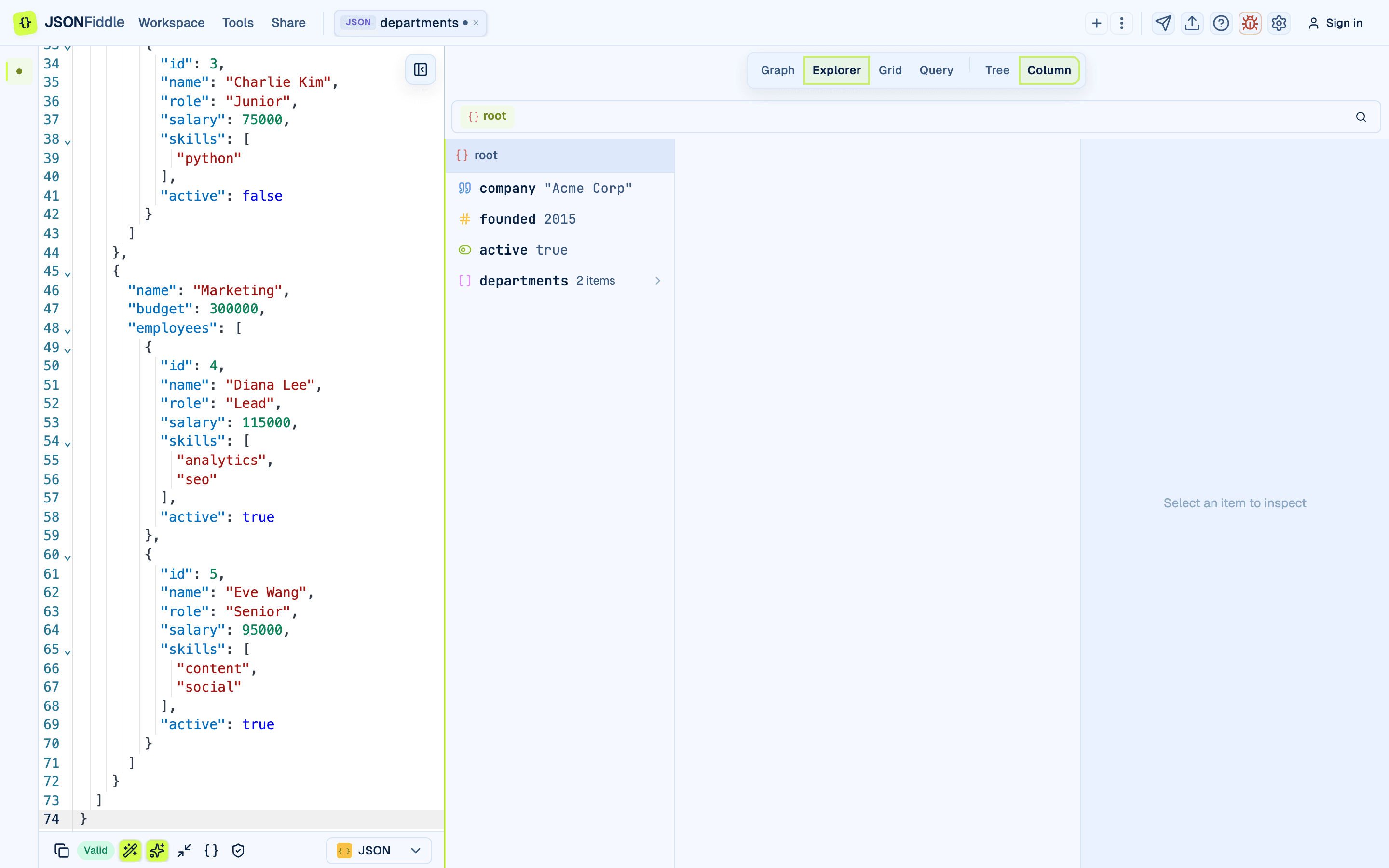
Explorer
Drill through large payloads column by column and inspect related values without losing context.
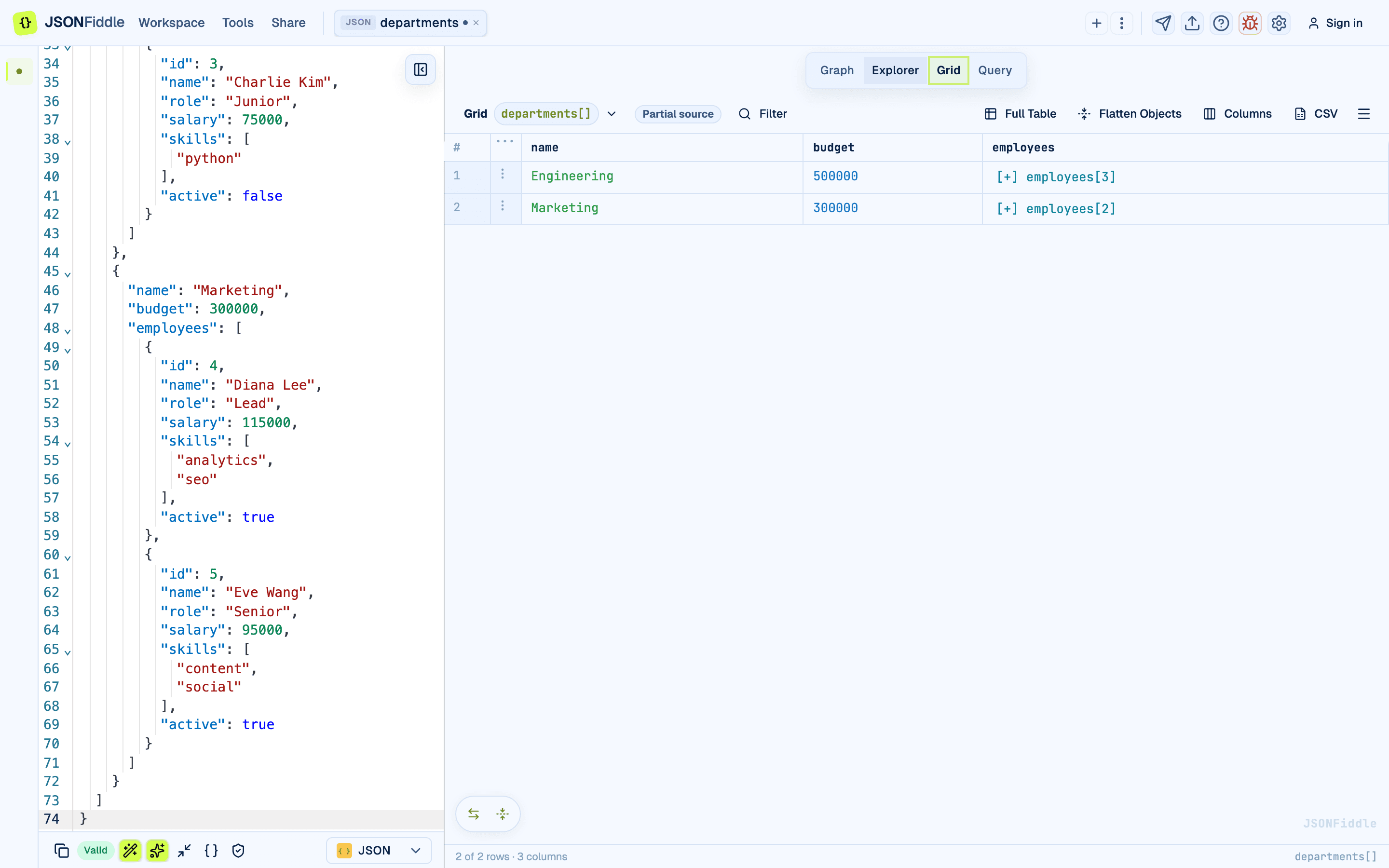
Grid
Turn arrays into spreadsheet-style tables, flatten nested fields, choose columns, and export.
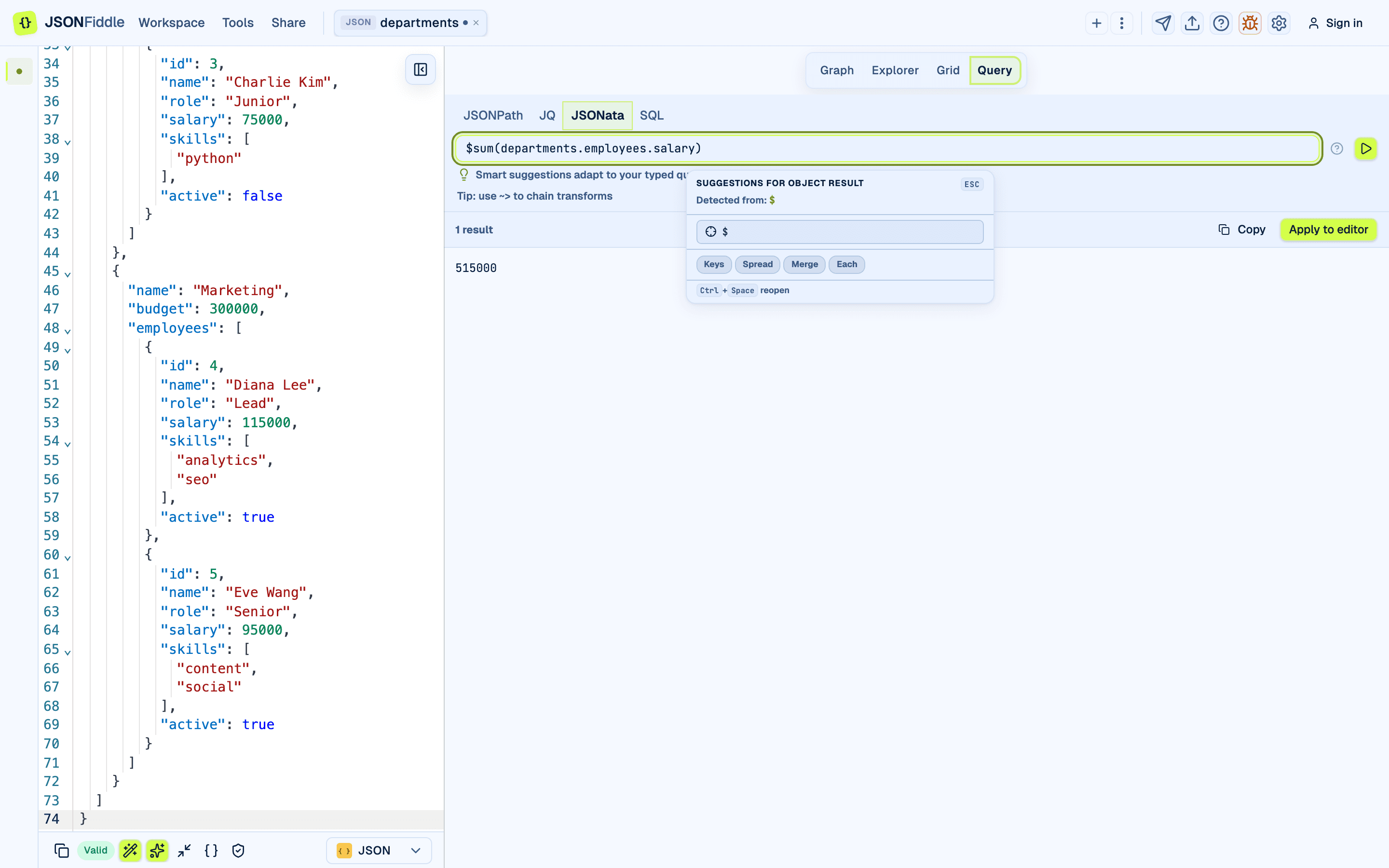
Query
Use JSONPath, JSONata, and JQ-style workflows to find the exact value or slice you need.
Postman sends the request. JSONFiddle explains the response.
Keep Postman for authentication, environments, and request execution. Use JSONFiddle when the hard part is understanding the payload: nested arrays, hidden nulls, schema drift, CSV exports, and stakeholder review.
Response comprehension
Graphs, grids, explorer, and query views make unfamiliar payloads readable.
Evidence for teams
Export CSVs, screenshots, diagrams, and shareable links for bugs and handoffs.
Contract confidence
Generate schemas and types from real payloads before implementing clients.
No script detours
Flatten nested objects and inspect arrays without writing throwaway JavaScript.
More than a formatter.
The tool library gives every team a clear path from “what is this response?” to “what do we do next?”
JSON Formatter
Beautify, repair, and minify messy responses.
JSON Diff
Compare staging vs production payloads.
Flatten JSON
Turn nested objects into CSV-ready fields.
SQL on JSON
Run ad-hoc analysis on response data.
Type Generator
Generate TypeScript, Go, Rust, and schemas.
Schema Validator
Validate payload contracts before shipping.
JWT Decoder
Inspect auth tokens during API debugging.
Large JSON Viewer
Open big files without losing the browser.
For API teams
Move from request success to response understanding. Validate payload shape, detect contract drift, and hand off reproducible evidence.
For support and success
Open customer payloads without reading raw JSON. Find fields, explain nested data, and share screenshots or links faster.
For data and operations
Flatten, filter, and export nested objects without waiting on an engineer or writing one-off scripts.
Free to inspect. Paid when JSON becomes team memory.
The free product wins on speed and utility. The paid product should unlock persistence, collaboration, governance, and heavier enterprise payloads.
Saved cloud files
Accounts can save and reopen JSON workspaces today. Version history is still planned.
Public share links
Share slugs are implemented now. Private client links and access controls are planned.
Large JSON workflows
Large-file viewing and worker-backed parsing exist today for heavier payloads.
Core exports
CSV, PNG, JPEG, and SVG exports are implemented. MP4 and export bundles are planned.
API collections and tests
No response collection or test-suite model is implemented in the current codebase.
Team governance
Roles, audit trails, team workspaces, and SSO are still roadmap features.